If I had a dollar for every time someone asked me how to build a high performing team, I’d probably be writing this from a beach somewhere.
It’s one of those questions that sounds simple enough, but the answer isn’t nearly as straightforward as people hope. There are countless books, podcasts and leadership experts all promising the secret sauce. Trust. Psychological safety. Accountability. Better communication. Clear goals. Strong relationships.
In fact, I started listening to the audiobook Radical Candor to see if I’m on the right track. Despite getting horribly bored halfway through (it’s an incredibly long book, and quite frankly rather overwhelming) I realised that the book didn’t have any groundbreaking ideas – it just had catchy phrases.
I digress.
None of those things are wrong, but if they were enough, every workplace would already have a high performing team.
The problem with looking for one solution
Over the years, I’ve worked with experienced leaders and teams across all sorts of organisations, and I’ve noticed something. When teams aren’t performing as well as they could, people often jump to a solution before they’ve properly understood the problem.
Someone decides the team needs more accountability, so they introduce more KPIs. Someone else thinks communication is the issue, so they schedule more meetings. Or perhaps they book everyone onto a team-building day and hope that spending an afternoon solving escape room puzzles will somehow transform the way people work together.
Sometimes those things help. Quite often, they don’t.
That’s because building a high performing team isn’t about finding one thing that’s broken. It’s about understanding that there are many facets to a high performing team. And of those facets, chances are there will be several areas to work on.
Individual performance isn't the same as team performance
One of the mistakes I see leaders make is focusing on one level at a time – or just focusing on one thing.
Some are brilliant at developing individuals. They coach their people, have regular one-on-ones, give thoughtful feedback and genuinely care about helping people grow.
Others naturally focus on the team. They spend time building culture, improving communication, clarifying goals and helping people work better together.
Both are worthwhile.
But here’s what I’ve found.
The best leaders don’t choose between developing individuals or developing teams. They know when to focus on each, and they also recognise there’s another level that’s just as important.
That’s the thinking behind what I call Zoom In, Zoom Out.
Zoom in on the individual
Sometimes the biggest barrier to a team’s performance comes down to one person.
Perhaps they’re unclear about what’s expected of them. Maybe they’re lacking confidence, haven’t developed the skills they need yet, or they’re simply in the wrong role.
When you zoom in, you’re looking at the individual. You’re asking questions like:
- Do they understand what’s expected?
- Are they using their strengths?
- Have they had honest, constructive feedback?
- What support or coaching would help them perform at their best?
Helping one person succeed can have a ripple effect across the whole team.
And I always say – employee engagement happens one person at a time. Each person has different goals, needs and motivators. Your job as a leader is to understand those for each person.
Zoom out on the team
Then there are times when the issue isn’t the individual at all. It’s the way the team functions.
This time, the questions are different:
- Do people trust each other?
- Are they comfortable challenging ideas?
- Does everyone understand what success looks like?
- Are they all rowing in the same direction?
- Are decisions made collaboratively, or does everything grind to a halt waiting for the manager?
I’ve seen plenty of teams made up of capable people who simply weren’t working well together. They weren’t lacking talent; they were lacking clarity, shared ownership and good habits.
That’s why building a team is different from managing individuals. It requires leaders to step back and look at the patterns rather than the people.
Zoom right out on the organisation
Here’s the part I think many leadership programmes miss altogether.
Even teams that work brilliantly together can still create problems if they don’t understand the wider system they’re operating in.
No team is an island.
Every team has customers, stakeholders, suppliers or colleagues in other parts of the organisation who are affected by the work they do, what they prioritise and the decisions they make.
I’ve seen teams proudly celebrate streamlining one of their internal processes, only to discover they’ve doubled the workload for another department. Technically they’d improved their own efficiency, but they’d made life harder for everyone else.
That’s not a high performing team.
A genuinely high performing team understands how its work connects with the rest of the organisation. It:
- thinks about stakeholder needs before making decisions
- works collaboratively with other teams instead of operating in silos
- considers the wider impact of changes
- brings people along rather than assuming everyone will simply adapt.
Those conversations don’t always happen naturally. They need leaders who encourage their teams to lift their heads, look beyond their own priorities and ask:
Who else does this affect?
Who else should be part of this conversation?
In my experience, that’s one of the biggest differences between teams that perform well within their own bubble and teams that make the whole organisation stronger.
High performing teams are built every day
I’ve always believed that good leadership development should change what people do when they get back to work.
A workshop can absolutely provide new ideas, practical tools and the confidence to tackle challenges differently. It gives leaders the opportunity to step back from the day-to-day, reflect on how their team is functioning, and learn approaches they can start applying straight away.
But building a high performing team doesn’t stop when the workshop finishes.
It happens in the hundreds of everyday interactions that follow:
- giving honest feedback instead of avoiding awkward conversations
- making expectations clear
- creating an environment where people can challenge ideas respectfully
- looking beyond the team’s own priorities
- considering the people affected by the team’s decisions.
Leadership development provides the foundation. It’s what leaders choose to do afterwards that turns those ideas into lasting habits and, ultimately, into high performing teams.
Why leadership development matters
We often promote people because they’re technically excellent at what they do.
Then we expect them to lead people without ever teaching them how.
Leadership is a skill. Building a high performing team is a skill. Thinking beyond your own team and leading across an organisation is a skill too.
The good news is that all those skills can be learned.
That’s exactly what we focus on in our Building High Performing Teams programme. Rather than offering another list of leadership theories, we give leaders practical tools they can use immediately.
You’ll learn how to:
- develop individuals
- strengthen team dynamics
- build collaboration beyond your own team.
Because that’s where sustainable performance comes from.
And if you’re looking to build stronger leaders across your organisation, we have several leadership development offerings that complement this training.
After all, high performing teams don’t appear by accident. They’re created by leaders who know how to bring out the best in individuals, build strong teams, and help those teams contribute to something bigger than themselves.
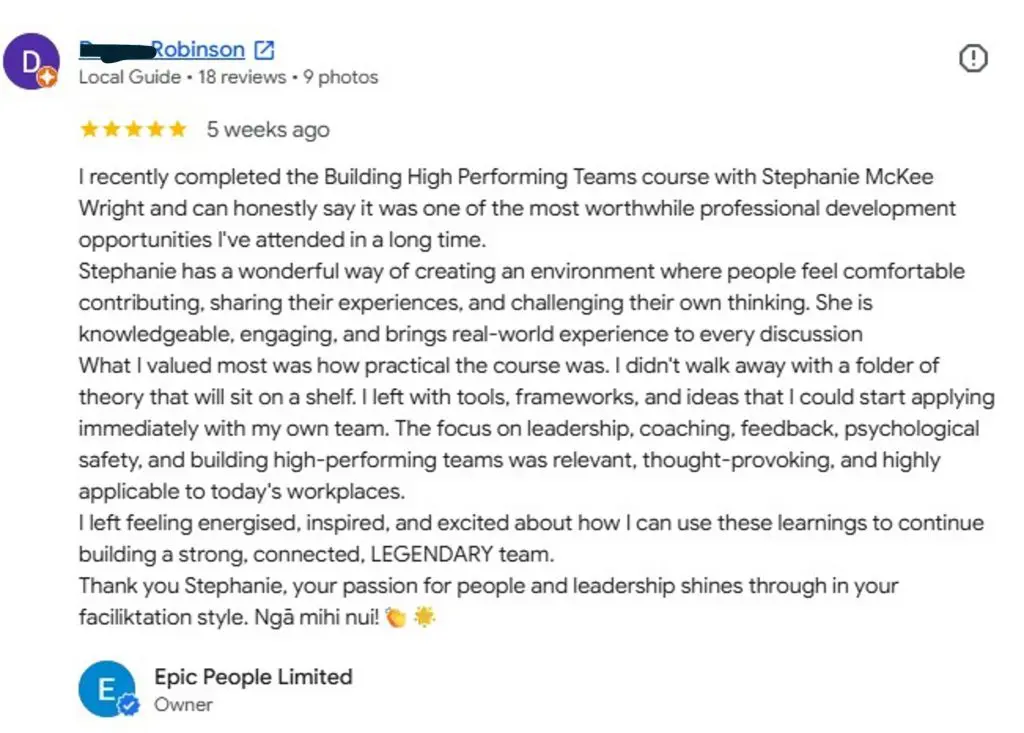
Feedback from our high performing teams training