Restructuring & Redundancy Support You Can Trust
Restructuring and redundancy support is one of the highest-risk employment law services we provide. Whether your business needs to restructure a team, reduce costs, introduce new technology or change the way work is organised, getting the process right is essential.
At Epic People, we provide practical restructuring and redundancy support for New Zealand employers. We help you design a commercially sensible proposal, manage consultation with affected employees, meet your legal obligations and reduce the risk of personal grievances.
Our approach combines practical HR advice with a clear understanding of New Zealand employment law, giving you confidence throughout the restructuring process.
We’ve supported kiwi employers through restructures ranging from single-position changes to more complex organisational redesigns.
When might a restructure be needed?
Restructuring isn’t just about cutting costs — it’s about making sure your business is set up to succeed.
You might be considering a restructure if:
- Revenue has dropped or costs need to be reduced
- You’ve lost a major client or contract
- New technology has changed how work gets done
- There are inefficiencies, duplication or unclear responsibilities
- Growth has created confusion or stretched your current structure
- You’re preparing for a sale, acquisition or transition
- You’re outsourcing or contracting out parts of the business
Sometimes the outcome is simply a better structure.
Sometimes, redundancies are part of the process.
When do redundancies come into it?
Redundancy happens when a role is no longer required — not when a person isn’t performing.
It can occur when:
- Duties are removed or significantly reduced
- Work is redistributed across other roles
- A function is outsourced
- Technology replaces manual tasks
- A new structure no longer includes certain positions
This is where many businesses get it wrong.
Redundancy isn’t just a decision — it’s a process. And that process must be fair, well-documented, and legally compliant. If your restructure may mean redundancies, then getting redundancy-specific advice is crucial.
Getting the process right matters
In New Zealand, restructuring and redundancy processes are heavily scrutinised – this scrutiny is inherent in the consultation process. The whole process has a series of steps which must be carefully planned and executed, especially when redundancies could be an outcome.
If you skip steps, rush decisions, or treat consultation as a formality (sometimes called a ‘sham consultation’), you risk:
- Personal grievance claims that soak up a lot of time
- Financial penalties in the tens of thousands of dollars
- Reputational damage in your profession or industry
- Negative impact on your employment brand
- Loss of trust across your workforce
Even when the outcome is justified, the way you get there matters just as much.

Thinking about restructuring? Talk to us early.
Most problems don’t come from the decision to restructure.
They come from how late people get restructuring and redundancy advice.
Book a quick, no-pressure call to sense-check your situation before you make any moves.
What the organisational restructuring process typically looks like
Restructuring can feel complex — but the process itself has definable steps that all New Zealand employers must follow.
Here’s how it usually works:
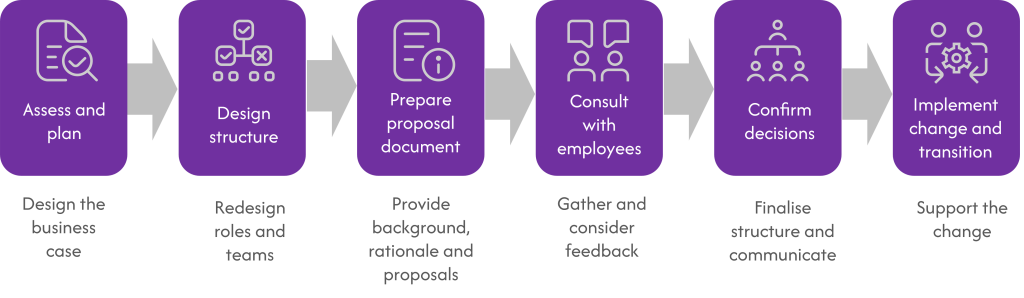
1. Assess and plan
You define the business reason for change and sense-check whether a restructure is the right approach.
We can help you get clear on risks, options, and the best path forward. We can help you to –
- Assess whether a restructure is genuinely needed
- Identify risks and alternative options
- Align changes with your business goals
2. Design the future structure
Roles, responsibilities, and reporting lines are reviewed and redesigned to fit your goals. Remember, this is a draft structure until consultation is finished and it might change.
We build practical, fit-for-purpose structures — not theoretical ones. We do this by –
- Reviewing current roles and responsibilities
- Designing a draft new organisation structure
- Develop clear, future-focused (proposed) job descriptions
3. Prepare documentation
A formal restructure proposal is developed, outlining the rationale and proposed changes.
We make sure everything is clear, compliant, and defensible. We can –
- Draft the restructure consultation document
- Ensure everything is compliant and defensible
- Work out the consultation timeline
4. Consultation
You present the restructure proposal to affected employees and invite feedback before making decisions.
We guide you through this step so it’s genuine, fair, and low risk. We can –
- Guide you through fair and compliant consultation
- Help you respond to employee feedback and ideas
- Support decision-making
5. Confirm decisions
Feedback is considered, and final decisions are made and communicated.
We help you navigate this carefully and sensitively — this is where many processes fall over. We can –
- Help you to plan clear, respectful messaging
- Coach you through difficult conversations with employees
- Help reduce confusion, backlash, and anxiety
- Be your restructuring coach every step of the way
6. Transition and implementation
The new structure is put in place, with support for leaders and teams through the change.
We help you maintain momentum, engagement, and clarity. We can –
- Help your team transition into the new structure
- Support your leaders through change
- Guide you through maintaining engagement and performance during disruption
- Helping with employee engagement throughout and after the change.
Not sure where you are in the process?
- Still thinking about change → start at Step 1
- Already drafted a proposal → you’re at Step 3
- Mid-consultation → Step 4 (this is high-risk — get support)
Get a quick second opinion before you move forward.
Where most businesses get stuck
Usually somewhere between steps 3–5.
That’s where risk spikes — and where the right advice makes all the difference.
Book a call if you want support at any stage of the process.

Business sales, acquisitions, mergers and contracting out
When you’re buying a business, you may be taking on some or all of the staff. If you’re selling your business, you may be negotiating the transfer of your employees to the new owners’ business.
If you’re merging your existing business with another business you’re buying, then you will potentially need restructuring advice or redundancy advice.
These are all situations in which you need to follow correct processes.
Contact us to talk through your responsibilities and options.
Why work with Epic People on your restructure?
/With over 30 years’ experience in HR and employment compliance in New Zealand, we’ve done countless restructures and downsizing processes. As well as being experts in the process, we provide an outsiders view, to help you to see things you might have overlooked. We understand that these processes are incredibly stressful for everyone, and our goal is to support you personally through the process.
We bring:
- Real-world experience — we’ve handled these situations in live environments
- Straight answers — no fluff, no overcomplication
- Balanced advice — protecting your business and treating people properly
- End-to-end support — from early thinking through to implementation
- Calm, practical guidance — when things feel uncertain or high-pressure
Most importantly, we help you make good decisions early — which is what reduces risk later. Check out our other services, such as HR strategy and advisory and HR compliance.

Frequently asked questions about restructures and redundancies
What is a restructure?
A business restructure occurs when you want to redesign roles and reporting lines in your organisation. It involves examination of the ‘current state’ of the organisation and understanding what needs to change to achieve business goals. Sometimes a restructure is in response to the organisation’s goals, business survival, or it’s triggered by an external event. In employment law, a restructure refers specifically to the sale or contracting out of a business, or part of a business.
Is restructuring the same as downsizing?
Sometimes an organisation restructure is triggered because downsizing needs to take place. Downsizing may be needed due to a downturn in business, loss of a client, contracting out some functions, or significant efficiency gains from new technology meaning less people are needed. The process of restructuring and downsizing is essentially the same.
Is restructuring and redundancy the same thing?
Redundancies may be one of the outcomes of a restructure. Whether or not redundancies are possibly going to happen, the process that must be followed is the same. Redundancies are an inevitable outcome of downsizing.
What is employee consultation?
By law you must consult with employees before making any decisions that affect their job or their terms and conditions of employment. This means providing them with background information, rationale for the proposal, a clear understanding of how their role could be affected, and how to provide feedback. Consultation must not be a sham – you must genuinely consider feedback and counter-proposals before making your final decision.
Do I have to consult with employees before making changes?
Yes. Consultation is a legal requirement, including when the business rationale seems obvious and known to everyone. Employees must be given a genuine opportunity to provide feedback before any decisions are finalised.
Can I make someone redundant and then hire someone else into a similar role?
Not usually. If the role still exists in a similar form, it may not be a genuine redundancy. This is a high-risk area and needs careful handling.
How long does a restructuring or downsizing process take?
It depends on the complexity, but most processes take a few weeks. Rushing increases risk, so we always advise taking it slow.
What’s the difference between redundancy and performance management?
Redundancy is about a role no longer being needed. Performance management is about an individual not meeting expectations.
Mixing these up is a common — and costly — mistake. You can not use a restructure and redundancies as an excuse to remove a poor performer. We can help you with employee performance management if that’s your real goal
Do I need to offer redeployment options?
Yes, where possible. Employers are expected to consider whether affected employees could reasonably move into other available roles.
What happens if an employee raises a personal grievance?
If the process hasn’t been fair or well-documented, you may be exposed to claims. Sometimes people will raise a personal grievance even if you get the process spot on. Getting advice early significantly reduces the risk of a personal grievance; and makes defending a personal grievance much easier.
Can I restructure to improve efficiency, even if the business is profitable?
Yes. Restructuring isn’t limited to financial distress — but the rationale must still be genuine and clearly explained.
Do I have to pay redundancy compensation?
There is no legal requirement to pay redundancy compensation. If redundancy compensation is in an employee’s employment agreement, you must pay it.
How much notice do I need to give employees that I’m making redundant?
You must give employees the amount of notice that is in their employment agreement. If there is no notice period for redundancy in the agreement, then refer to any general clause about giving notice.
Do you work with small businesses or only large organisations?
Both. We tailor our approach based on your size, complexity, and level of internal capability. The overall process is the same whether your organisation has two or two hundred employees.
Do you have training for managers thinking about restructuring?
Yes, we cover the rules and procedures for restructuring in our employment law basics for managers and small businesses training.
Need to talk it through?
Behind every epic workplace, is Epic People
If you’re even thinking about restructuring, it’s worth getting advice early.
A short conversation now can save you a lot of time, cost, and stress later.