Kiwi leaders are genuinely great at using data to make decisions — whether that’s technical, financial, or operational. But when it comes to recruitment and retention, many of us are working with incomplete data. We make decisions based on urgency, gut feel, or experience, which is understandable given the pressure of running a business or a team. The problem is that it also means we sometimes hire the wrong people or quietly lose or disengage the ones we most needed to keep. And this is because many organisations don’t have an employee listening strategy.
So, here’s the central idea I want to share with you: employee listening is data. And if you’re not collecting it, you’re guessing.
What follows is a practical look at how to use employee listening — not as an HR activity — but as a genuine tool for making smarter recruitment and retention decisions, especially in businesses where you don’t have a large HR team behind you.
It starts before you even post the job
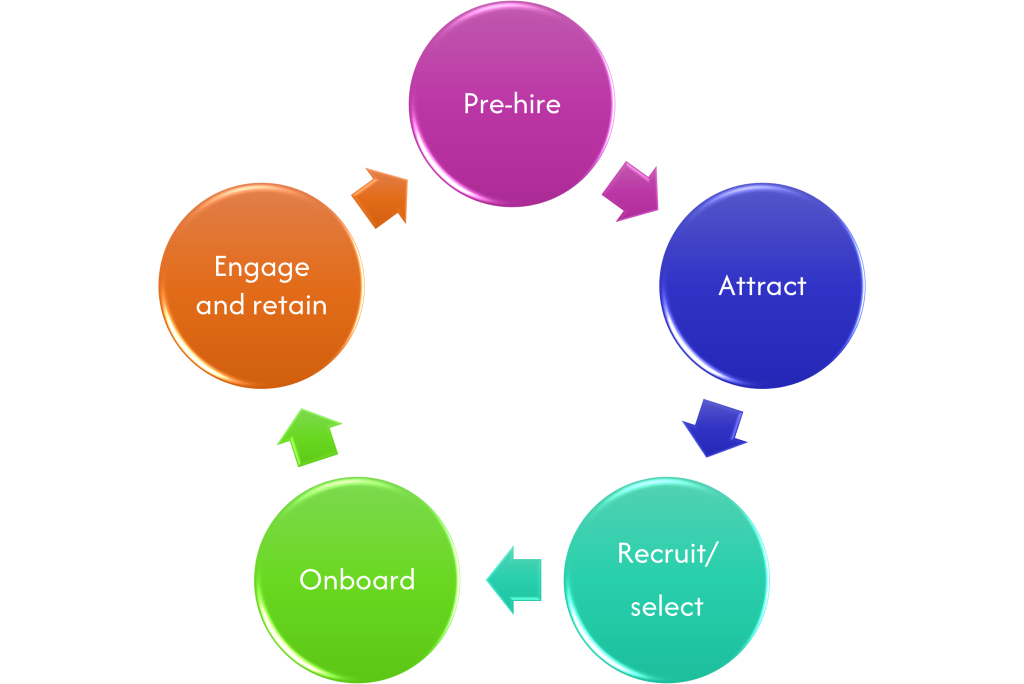
Let me introduce what I think of as the Employee Experience Cycle. This covers some of they key touchpoints from before someone joins through to the moment they’re fully contributing and thriving. And it starts much earlier than most people think — it starts at prehire.
Most hiring begins with one of two triggers: “we’re busy, we need another person” or “someone has resigned and we need to replace them.” Neither of those is a strategy. Both are reactions.
Before you kick off any recruitment process, there’s an important strategic question worth sitting with:
Are you going to buy, borrow, or build capability?
- Buy — hire someone new from the market
- Borrow — bring in a contractor or short-term resource
- Build — develop or promote someone from within
Because we tend to be focused on the immediate problem, we often default to “buy” without really questioning whether it’s the right call. But this decision has long-term consequences for your capability, your culture, and your retention outcomes. Even at this very first stage, the question is whether you’re making a deliberate, strategic decision — or a reactive one.
A simple way to make this more deliberate is to write yourself a business case before starting the hiring process. It doesn’t need to be a corporate document — it just needs to make you think clearly about what you actually need and why. → Get in touch if you’d like a business case template to work from.
You might be wondering at this point, what’s this got to do with employee listening? Read on to the end to find out.
The recruiting stage is also an employee listening opportunity
We tend to think of recruitment in terms of employer brand, your LinkedIn presence, candidate experience, and what people hear about working with you. All of that matters. But there’s something happening during interviews that often gets overlooked; and this is where employee listening is totally underrated.
Candidates give you a huge amount of data, if you’re paying attention. The questions they ask, what they get excited about, why they left their last role — these are all signals. They might be asking about career growth, development pathways, what success looks like in the role, your culture, or flexibility. And if they accept your offer, they’re doing so because they believe you can meet those needs and that there’s a future for them with your organisation.
The question is: are you actually listening? And are you capturing that information somewhere useful, or letting it drift away once the offer is signed?
If your team could benefit from sharpening up how you run interviews and read these signals, our Recruitment Skills training is worth a look.
Onboarding is where expectations meet reality
Onboarding is one of the biggest ‘moments that matter’ in the employee lifecycle — not because of induction paperwork, but because this is when a new hire is actively looking for evidence that what they were told during recruitment is actually going to happen.
This makes it a prime opportunity to listen. A short questionnaire or 15-minute feedback conversation around the hiring and onboarding experience can tell you a lot. You’re specifically trying to understand whether their expectations are being met, what’s working, and importantly, what isn’t. If you have open-ended questions in there, people will naturally comment on the things that matter most to them — and that’s valuable intelligence.
There’s another benefit too: by asking for feedback at this stage, you’re demonstrating that you have a culture of employee listening. That signal matters — as long as you actually act on what you hear.
Here’s something worth knowing: retention risk doesn’t usually start at year three. It often starts in the first 90 days, when expectations quietly don’t quite land the way someone hoped.
Engagement and retention: moving beyond the survey
Once someone is settled in, most organisations have some kind of employee listening activity in place. Annual engagement surveys, pulse surveys, 360-degree reviews — these all have their place and they give you a useful organisational view.
But they don’t give you the full picture. And in smaller organisations, you often don’t get enough data at a team level for the results to be particularly meaningful or actionable.
This is the mantra I come back to again and again: engagement happens one person at a time.
According to Gallup research, managers have a 70% impact on employee engagement. That’s not a small number — it means that if you want to retain the right people, you need to understand them individually. Because while you’re focused on today’s delivery, your people are always thinking about their future. Nobody wants to look back after three to five years and feel like their time with you was a wasted chapter. then is when employee listening needs to go to a deeper level, and we’ve got tools to help with that.
If you’re looking to build your capability as a leader in this space, our Team Leader Training and Advanced Coaching Skills for Managers courses are specifically designed to help with exactly this kind of individual-level engagement.
A practical tool: the willing and able matrix
So how do you actually turn this into something actionable? Here’s a tool I use in my training programmes — I call it the Willing and Able Matrix.
The idea is simple. You’re looking at two dimensions for each person on your team:
Able covers things like technical skills and how developed they are, depth of knowledge, communication and presentation skills, judgement in complex or ambiguous situations, and the quality and consistency of their work.
Willing is about motivation — the internal drive someone brings to their work. It shows up in whether they turn up with energy and purpose or are going through the motions, whether they actively seek to learn and grow, how they approach challenges, whether they go beyond what’s expected when it counts, and whether they reliably follow through.
When you place people on this matrix, you get four broad groups — and each calls for a different response:
High willing, low able → develop them.
High willing, high able → challenge and grow them.
High able, low willing → find out what’s going on.
Low willing, low able → clarify, support, and if needed, manage performance. Our Managing Poor Performance training can help you navigate that process confidently.
We explore the Willing & Able matrix in detail in two of our training courses: Advanced Coaching Skills for Managers and Building High Performing Teams.
The key point here is that you can’t take the right action if you don’t have the right data. And this is exactly where a structured and employee listening tool — like an individual engagement and development questionnaire used at least once or twice a year — becomes incredibly useful. Pair it up with the impressions that you used when completing the Willing & Able matrix – these two things create a powerful combination. Use individual questionnaires it as the basis for a genuine conversation about what each person needs, what’s driving them, and what you need to do to grow them, retain them, or — sometimes — start a different kind of conversation altogether. And when you’re in these meetings, don’t forget your active listening too!
Closing the loop: back to buy, borrow, build
Closing the loop: back to buy, borrow, build
Here’s where it all comes together. Remember that buy-borrow-build question from the start? The reason employee listening matters so much to that decision is this: if you’ve been doing this well — using the Willing & Able matrix, running individual engagement conversations, genuinely getting to know your people — then when you next need more capacity, you’ll have real data to inform your decision.
You’ll know who’s ready to step up (build). You’ll know what gaps genuinely need to be filled from outside (buy). And you’ll have a clearer sense of when a short-term solution makes sense (borrow in the form of an internal secondment). That’s a very different conversation from “someone left — let’s post a job ad.”
If you’d like support building out your culture and engagement approach or want some HR advisory support to make employee listening a more structured part of how you operate, we’d love to talk.
The takeaway
Employee listening isn’t a survey. It’s a continuous process of collecting data — from the very first interview conversation through to your regular one-on-ones with your longest-serving team members. When you do it well, you make better hiring decisions, you retain the right people, and you build a stronger organisation over time.
Better data leads to better decisions. And that starts with actually listening.
Interested in exploring how Epic People can support your team’s development and retention, or build an employee listening strategy? Get in touch with Stephanie or explore our training courses and HR consulting services.